
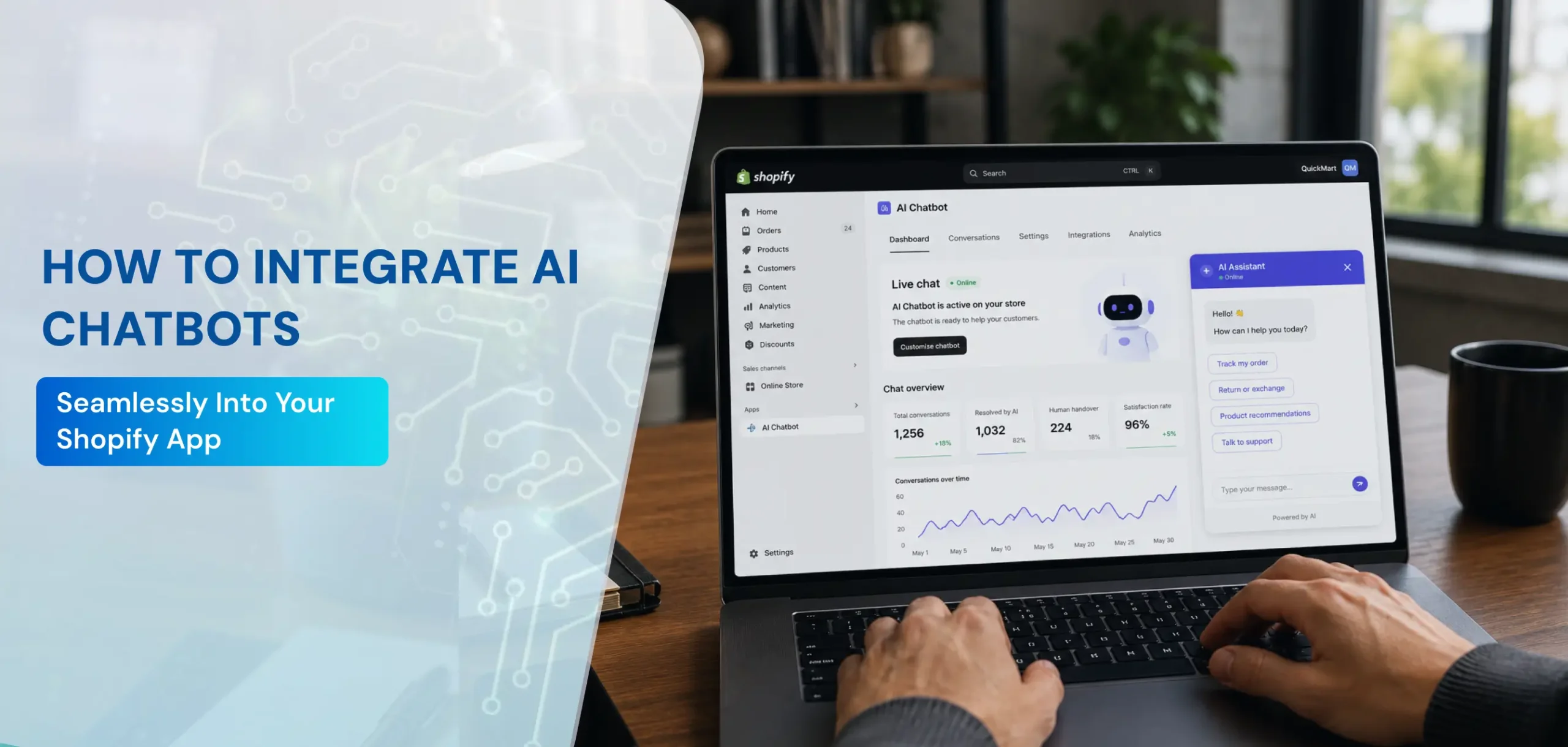
In today’s fast-paced e-commerce landscape, instant customer support can make or break a sale. Shoppers expect quick responses, personalized assistance, and seamless interactions, especially on mobile apps. Integrating AI chatbots into your Shopify app offers a powerful solution, enabling automated support, personalized recommendations, and improved engagement, all while reducing operational costs.
In this blog, we’ll explore how to integrate AI chatbots seamlessly into your Shopify app, covering best practices, strategies, and benefits for e-commerce businesses in 2025.
Why AI Chatbots Are Essential for Shopify Apps
The rise of mobile commerce and changing customer expectations have made AI-powered chatbots a vital component of modern e-commerce:
- Instant support: Chatbots respond immediately to inquiries, reducing wait times and cart abandonment.
- 24/7 availability: Unlike human agents, AI chatbots can provide round-the-clock assistance.
- Personalized shopping experiences: By analyzing user behavior, chatbots can suggest products, promotions, and upsells.
- Operational efficiency: Automating repetitive tasks frees up human agents for complex queries.
For Shopify apps, AI chatbots enhance user experience, boost conversions, and improve customer loyalty.
1. Define the Chatbot’s Purpose
Before integration, it’s crucial to identify the chatbot’s role in your Shopify app. Common objectives include:
- Answering FAQs about products, shipping, and returns
- Assisting with checkout and order tracking
- Providing personalized product recommendations
- Offering promotions and loyalty program information
Clearly defining the chatbot’s purpose ensures it aligns with your business goals and provides value to users.
2. Choose the Right AI Chatbot Platform
Several AI chatbot platforms integrate smoothly with Shopify. Consider factors like:
- Natural Language Processing (NLP) capabilities to understand user queries
- Multi-channel support (mobile app, web, social media)
- Customizability and branding to match your Shopify store
- Analytics and reporting for performance insights
Popular platforms include Dialogflow, IBM Watson Assistant, Tidio, and ManyChat, which can integrate directly into Shopify apps.
3. Seamless User Interface Design
A seamless UI/UX integration is crucial for chatbot adoption. Best practices include:
- Ensure the chatbot is easily accessible from product pages, checkout, and the main menu
- Use intuitive conversation flows to guide users naturally
- Include quick reply buttons for common queries to reduce typing effort
- Avoid interrupting the user experience with intrusive pop-ups
Well-designed chatbots enhance engagement and conversion rates while maintaining a smooth app experience.
4. Personalization with AI
AI chatbots can leverage user behavior and purchase history to provide personalized recommendations:
- Suggest products based on browsing or cart contents
- Offer promotions tailored to individual preferences
- Engage returning customers with targeted messages
Personalization increases customer satisfaction, repeat purchases, and average order value.
5. Automate Order Management and Support
Beyond customer engagement, AI chatbots can streamline order management tasks:
- Provide real-time order tracking updates
- Assist with returns, cancellations, and exchanges
- Automate responses for shipping inquiries, payment issues, or loyalty points
Automation reduces manual workload and ensures consistent and accurate support across all interactions.
6. Leverage Analytics for Continuous Improvement
Analytics play a crucial role in optimizing chatbot performance:
- Track metrics such as response time, resolution rate, and user satisfaction
- Monitor the most common queries to update conversation flows
- Identify drop-offs in interaction to improve UX
By using analytics, Shopify store owners can continuously refine their chatbot for better engagement and higher conversions.
7. Multi-Language and Multi-Channel Support
To reach a broader audience, AI chatbots should support:
- Multiple languages for international users
- Integration across mobile app, web, and social media channels
- Consistent experience across all touchpoints
Multi-channel chatbots ensure customers receive timely support wherever they shop, enhancing loyalty and retention.
8. Ensure Security and Privacy Compliance
E-commerce apps handle sensitive data like payment information, addresses, and order history. Best practices include:
- Encrypting chatbot communications to protect customer data
- Complying with privacy regulations like GDPR and CCPA
- Limiting access to sensitive information within AI workflows
Secure chatbots build trust and confidence among users, which is essential for Shopify stores handling high-value transactions.
9. Test and Optimize Chatbot Performance
Before fully launching, conduct rigorous testing to ensure the chatbot works flawlessly:
- Test on different devices and operating systems
- Simulate real user queries to ensure accurate responses
- Gather feedback from beta users to refine conversation flows
- Continuously monitor performance after launch and optimize
Regular testing ensures the chatbot provides a seamless and satisfying experience for users.
10. Future Trends in AI Chatbots for Shopify
AI chatbots are evolving rapidly, and staying ahead requires awareness of emerging trends:
- Voice-enabled chatbots for hands-free shopping
- Predictive chatbots that anticipate user needs before queries
- Integration with AR/VR shopping experiences
- Self-learning chatbots that improve with every interaction
Adopting these trends allows Shopify store owners to deliver next-generation mobile experiences that engage and convert customers effectively.
Integrating AI chatbots into Shopify apps is no longer optional it’s a necessity for businesses looking to provide instant, personalized, and efficient support. From enhancing UX and automating order management to improving personalization and ensuring security, AI chatbots deliver measurable value for e-commerce stores.
By following best practices, defining chatbot goals, choosing the right platform, seamless UI design, personalization, automation, analytics, multi-channel support, and security compliance, Shopify store owners can create a high-performing, customer-centric mobile experience.
At Gradient Eye Technologies, we specialize in AI chatbot integration, Shopify mobile app development, and e-commerce optimization, helping businesses build intelligent, responsive, and secure apps that drive engagement and revenue growth.